
Historical Archives
Saint Paul’s Episcopal Church (often called “Saint Paul’s” or “St. Paul’s”) is one of Minneapolis’s oldest Episcopal parishes, founded in 1880, with early worship gatherings held in a rented vacant store on Hennepin Avenue.
Founding and early downtown era
The congregation began in 1880, and within about a year it broke ground on its own church building on Hennepin Avenue (between 12th and 13th Streets).
As membership grew, the parish’s buildings and location evolved over time as part of a pattern of “architectural innovation” tied to serving the community.
Moves and later campus development
A major transition came in 1902 when the church decided to move its building to a new site at Franklin and Bryant (a significant undertaking for the era).
By the mid-20th century, the parish again needed more suitable space, which led to integrating the Searle mansion (at Logan and Franklin) into the church’s facilities after it became available for purchase.
Parish house and wider role
The parish house associated with Saint Paul’s was originally built in 1915 and completed in 1916 for grain businessman Augustus Leach Searle and Helen Smith Searle, designed by Trowbridge and Ackerman.
A parish history note also describes Saint Paul’s as an early Episcopal church in Minneapolis that was asked to mentor five mission churches (naming several that became strong and active).

From the Parish Archives: Lake of the Isles
Did you know? Lake of the Isles was once a swamp. The Minneapolis Park Board chose the beautification of the lakes as their most important task. They virtually remade the landscape. The dredging process began on Lake of the Isles in 1889 and continued till 1893. The...

From the Parish Archives: Camping
Camping was awarded to boys who sang in the choir. For many years St. Paul's choir consisted of boys and camps were well attended. But in the late 1970's the number of young men and boys dwindled. With changes in the choir, it was inevitable for the first time in 50...

From the Parish Archives – Camp Lawton Part II
The buildings at Camp Lawton: As you enter Camp Lawton from the road, Goodwin Hall, the dining hall, is close to the road. There is a full kitchen and wash area, commercial stove, refrigerator and freezer. Storage for all equipment and dishes. A bedroom and bathroom...
From the Parish Archives – July 2017
For many years, Saint Paul’s Parish owned a summer camp for boys, girls, and families. Starting in 1898, and for more years, the choir director took the boys from the choir to Edgewood on Lake Minnetonka. They boarded a steam train for the ride to the lake, then hiked...

From the Parish Archives
During World War II a Red Cross unit worked for the program "Bundles for Britain" at St. Paul's. When the United States entered the war the unit was divided into two teams - one sewed hospital gowns, the other prepared surgical dressings. Some 125 women made thousands...

From the Archives – Neighborhood Involvement Program
by Rose Nightingale In 1969, Saint Paul’s joined with four other congregations in Kenwood to found the Neighborhood Involvement Program (NIP) under the direction of Social Worker, Judy Justad. It was designed to focus their joint ministry to help meet a diverse array...

Contemporary Service – from the archives
In the 1960s winds of change swept the church as well as society. City population declined sharply, including that of Minneapolis. With it went the membership of inner-city churches. Civil rights and peace movements weighed on everyone’s consciences. Ancient...
From the Parish Archives – Stained Glass Windows
by Rose Nightingale On January 1, 1963, the house in Edina of the Rev. Vernon Johnson was sold back to him. The church had purchased it from him when he became rector, to be used as the rectory (years ago the church used to own the house the rector lived in. Now the...
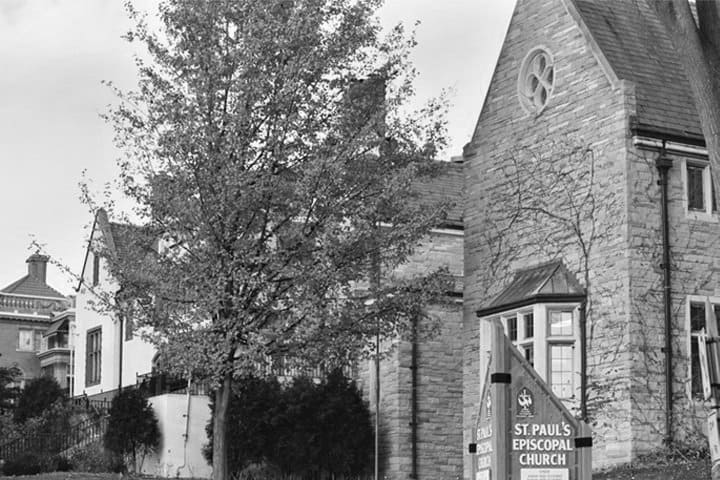
Advent Sunday 1958
The goal of holding services in the new church building was Advent Sunday, 1958. Much of the furniture from the old church was transferred to the new church. Worship in the old church was in pretty bare surroundings. The memorial organ (which has since been replaced...
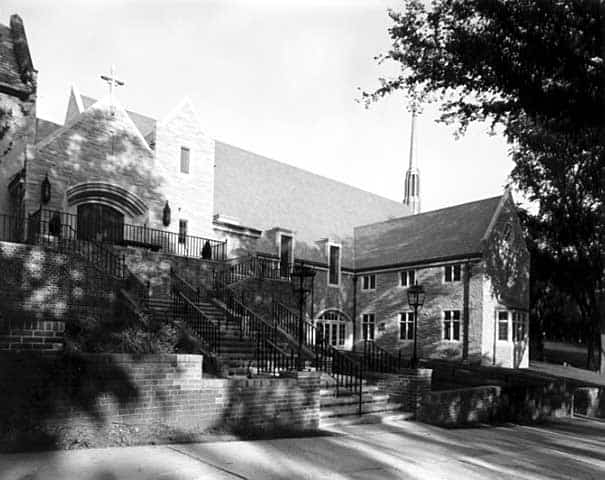
Groundbreaking
Ground was broken [for Saint Paul’s new building] in late October 1957. The November bulletin contained the Rector’s letter. “This week I had a visit with a man who is to have a great deal to do with our future. He is a tall man whom you can see on the ground at all...